Ask most restaurant owners in Delhi NCR where their customers come from and the answer is some mix of Zomato, Swiggy, Instagram and word of mouth. Ask how many of those customers they could contact directly tomorrow, and the answer is usually none.
That is the actual problem, and it is not really about websites. It is about who owns the relationship with the person who ate at your restaurant last Saturday.
What the aggregators are and are not
The platforms genuinely work. They put you in front of people who have never heard of you, they handle payment, and they solved discovery for an entire industry. Nobody serious is telling you to leave them.
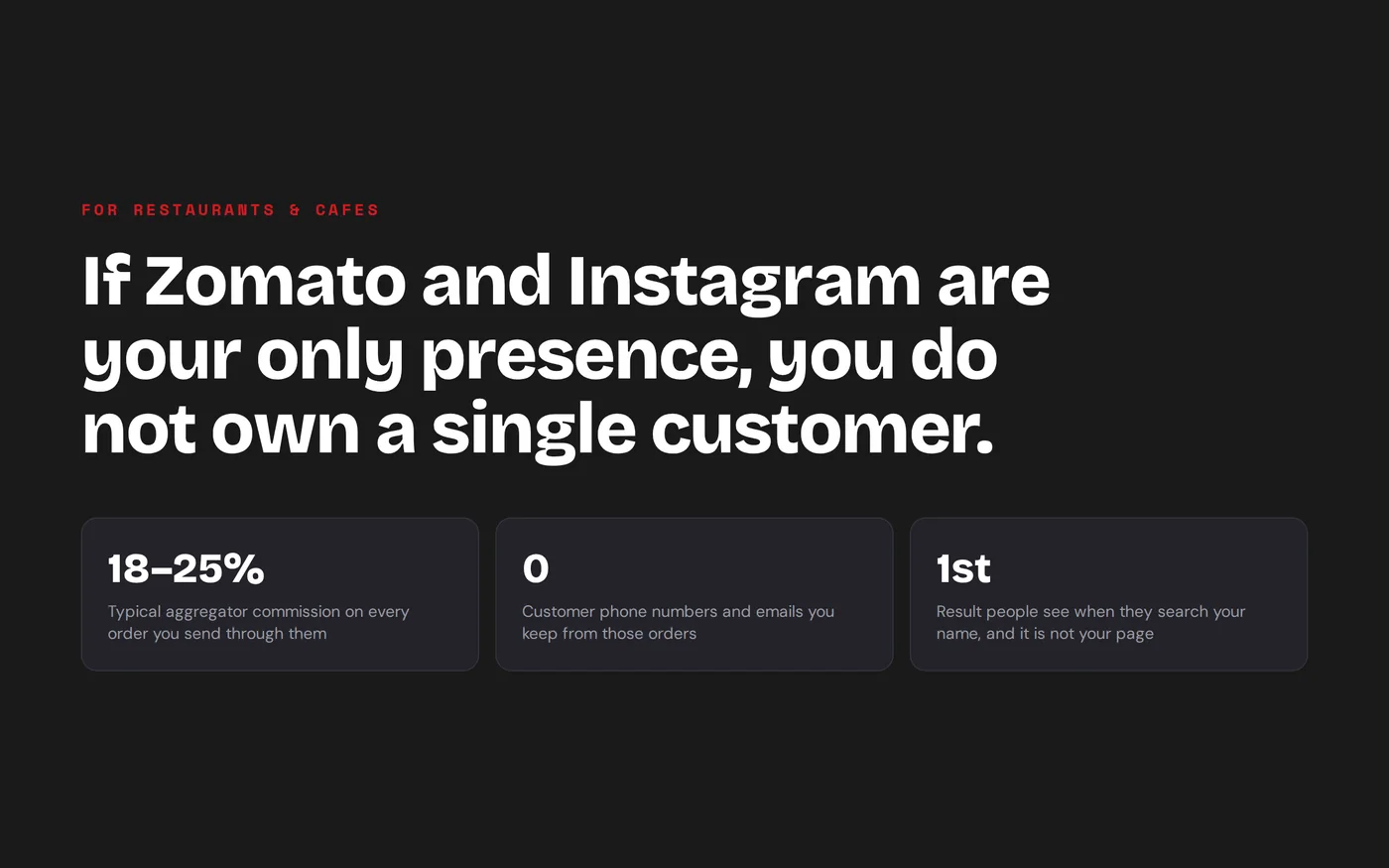
But the deal is worth reading carefully. You pay a commission on every order. You appear inside a list of competitors, sorted by criteria you do not control. The customer's name, number and ordering history belong to the platform. And the moment you stop paying for visibility, the visibility stops.
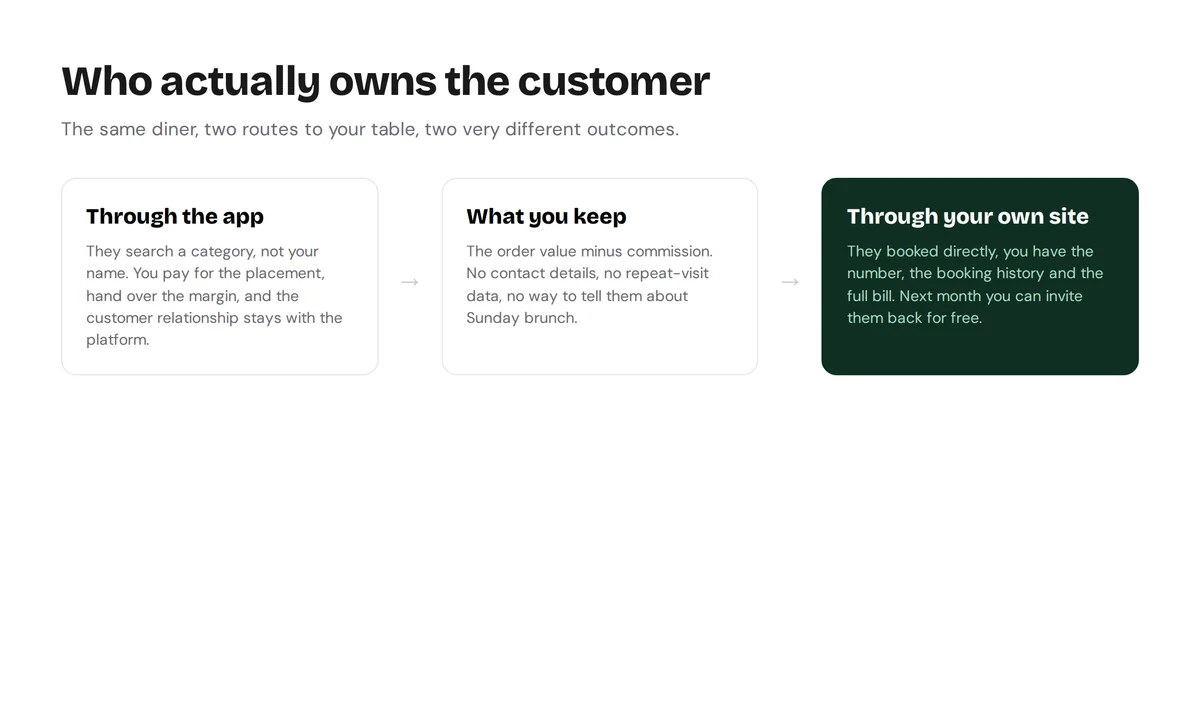
Instagram has the same shape with a friendlier face. Your following is real, but it sits on rented land. Reach changes when the algorithm changes, your posts reach a fraction of the people who followed you, and there is no way to contact a follower who has not messaged you first.
Could you fill a slow Tuesday by yourself?
If tomorrow is quiet and your only options are paying for an app promotion or posting and hoping, you do not have an audience. You have access to someone else's. A contact list of past diners is the one asset that answers that question with a yes.
Six jobs, and nothing else
Restaurant websites fail when they try to be brochures. Sliding image galleries, a chef's philosophy essay, a menu locked inside a PDF that has to be pinch-zoomed. Nobody reads any of it.
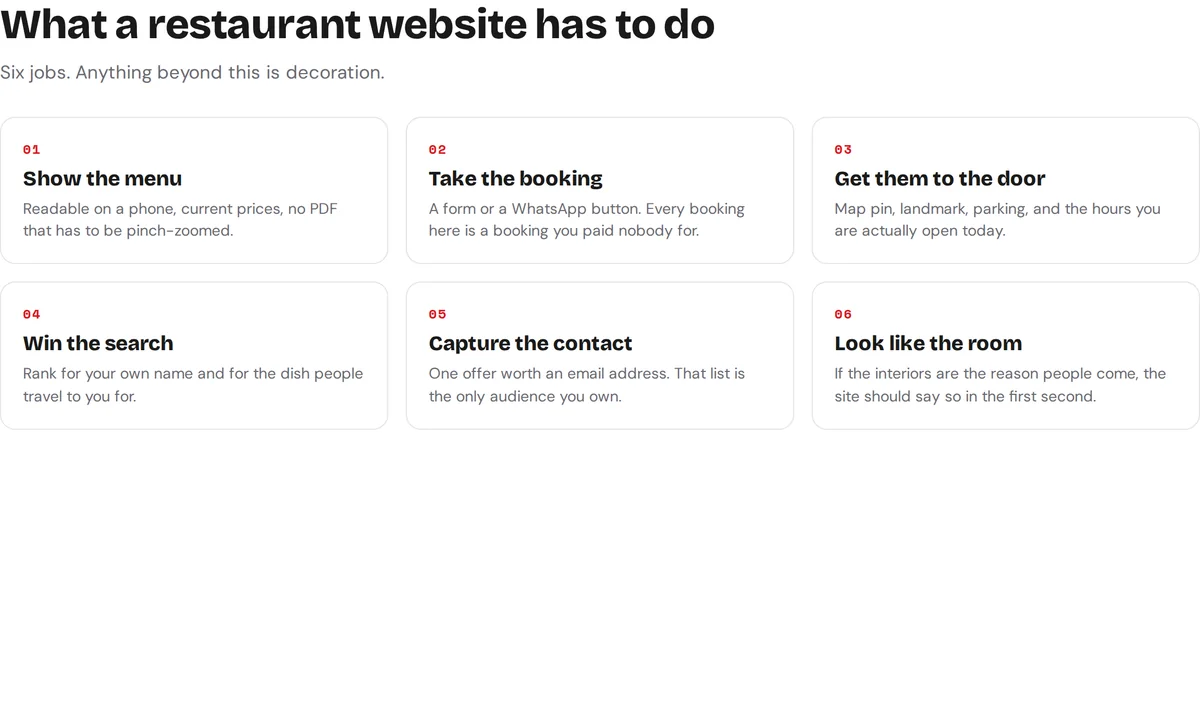
Two of those six carry most of the value. The direct booking, because every reservation that arrives through your own page is one you paid no commission on. And the contact capture, because a list of a few hundred past diners who chose to hear from you is worth more than several thousand passive followers.
The search point nobody mentions
Search your restaurant's name right now. If the first several results are aggregator listings, then those platforms are collecting the intent of people who were specifically looking for you. Those customers had already decided. They were not browsing a category, they typed your name, and the commission was charged anyway.
A basic site on your own domain usually takes the top result for your own name within a few weeks. That is the cheapest margin you will ever recover.
We build restaurant sites, and we bring the audience
A single-page site with menu, bookings and directions starts at ₹2,999 plus ₹2,000 for domain setup. Five-page sites with a gallery and separate menus start at ₹5,999. Our Business and Community package pairs the site with activation across our 51K-member Delhi Foodiez group at ₹24,999 a month.
Where the community part comes in
A website without traffic is a signboard in a basement. This is the honest limitation of every "just build a site" argument, and it is why we do not sell websites on their own to restaurants.
What moves a restaurant in Delhi NCR is a real diner posting a real photo in a group where 51,000 people are already talking about where to eat. That post drives the search, the search finds your site, and your site takes the booking and keeps the contact. The site is the part that catches what the community sends. Neither half works properly alone.
You can see the effect on this blog. Two of our recent member reviews were of restaurants nobody commissioned, written by people who paid their own bills. Those posts are still bringing readers to those restaurants. The only thing missing from that chain, for most places, is somewhere of their own for those readers to land.