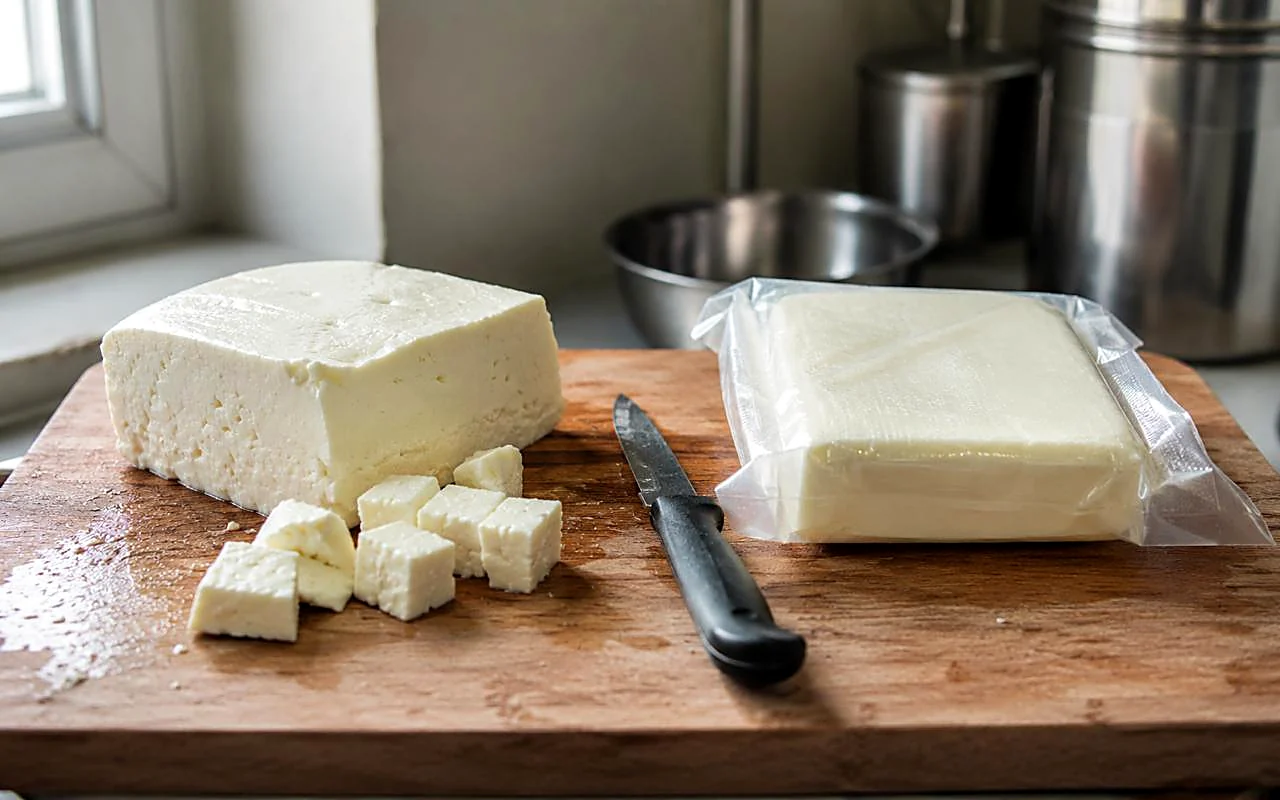
There is a product on Indian shelves that looks like paneer, cubes like paneer, sits in the same fridge as paneer and costs noticeably less. It is called a dairy analogue, and legally it is not paneer at all.
Analogue paneer is typically built from vegetable oil, starch and emulsifiers standing in for milk. FSSAI defines a dairy analogue as a product where non-milk constituents replace milk constituents in part or in whole while the result still resembles the dairy product. Analogue paneer is the most commonly sold one in the market.
It is not illegal to make or sell. It is illegal to sell it as paneer. The gap between those two things is where shoppers get caught.
What the law actually requires
Under FSSAI's standards, paneer must be made from cow or buffalo milk coagulated with sour milk, lactic acid or citric acid. It must carry not less than 50 percent milk fat on a dry matter basis, and moisture must not exceed 70 percent. Starch, non-dairy fats and synthetic milk are not permitted. Anything sold as paneer that misses these is adulterated under the law, whether or not anything was added deliberately.
There is a second, stricter standard worth knowing. The BIS specification caps moisture at 60 percent rather than 70. It is voluntary, and manufacturers who adopt it are generally the ones positioning on quality. Less water for the same weight is a better deal for you either way.
FSSAI has been tightening this, publicly
In 2025 the regulator issued an advisory on analogue labelling, held stakeholder meetings, and opened a consultation paper inviting public comment. Among the proposals: restricting analogue manufacturers to State and Central licences rather than basic registration, and limiting loose sale so analogues cannot be passed off as dairy without a label. The reason this is being fought over is that the substitution is hard to spot by eye.
The ten-second label check
Turn the pack over before it goes in the basket. The ingredients list on real paneer is short and boring, which is exactly what you want.
What should be there: milk, and an acidulant such as citric acid or lactic acid. Sometimes salt. That is close to the whole list.
What should stop you: vegetable oil, hydrogenated vegetable fat, modified starch, emulsifier, or stabiliser. Any of those in something calling itself paneer is a problem. The word "analogue" anywhere on the pack is the manufacturer telling you outright, and by law it has to be distinct rather than buried.
Then check the nutrition panel. Protein is the number that separates the two categories fastest, because starch and vegetable oil cannot fake it. Real paneer sits in a meaningfully higher protein band than an analogue does. If a pack of paneer is showing single-digit protein per 100g, something has been swapped.
Price is the tell, and we all ignore it
Paneer takes roughly four to five litres of milk per kilo. Work out what that milk costs today, and a pack priced far below the rest of the shelf has to have found the difference somewhere. Cheap paneer is not a bargain, it is an ingredients list you have not read yet.
Two checks you can run at home
These are the standard consumer-level tests, and they are genuinely simple.
Iodine for starch. Put a drop of iodine solution on a small piece. If it turns blue-black, starch is present, and starch has no business being in paneer. Iodine tincture from any chemist works.
Boil and watch. Heat a piece in water. Real paneer softens and holds. A soapy or oily residue on the surface, or a piece that goes slick and separates rather than softening, points to non-dairy fat.
There is a third signal you already know without being told. Paneer that squeaks hard against the teeth, refuses to absorb any masala, and stays rubbery no matter how briefly you cook it is usually telling you something about what it is made of, not about your cooking.
The loose paneer problem
Everything above depends on a label. Loose paneer from a counter has none. No ingredients list, no nutrition panel, no FSSAI licence number, no manufacturing date.
Plenty of loose paneer is excellent, particularly from a dairy you have used for years and can ask questions of. But it is bought entirely on trust in the seller, and that is precisely why FSSAI has proposed restricting analogues to packaged form. If you buy loose, buy from someone whose name you know, and be more suspicious of an unusually good price there than anywhere else.
Found a dairy in Delhi NCR whose paneer is consistently worth the trip? Post it in Delhi Foodiez. The best member posts get featured on our Community Wall with full credit.